
Boat Life · Cape Coral
5 Cape Coral Canal Systems: Which One Fits Your Boat
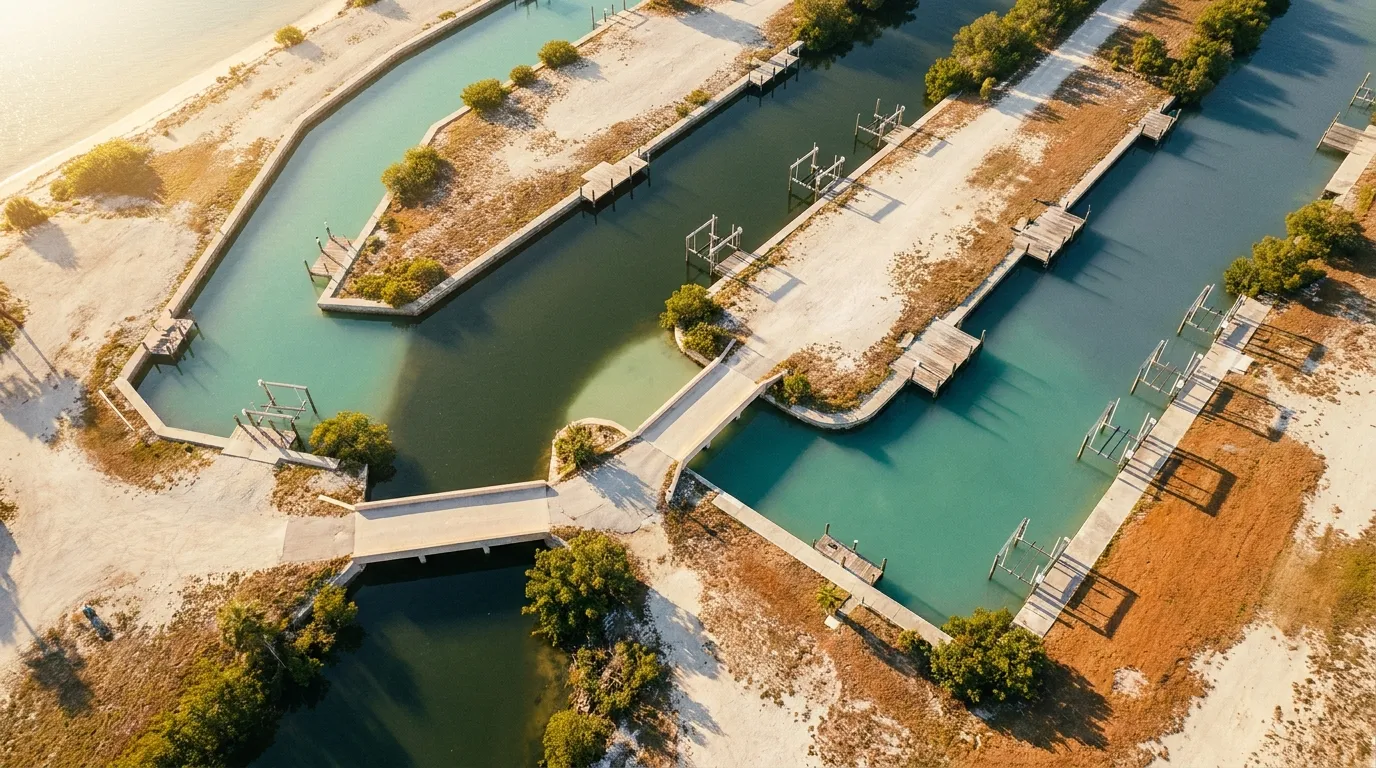
People move to Cape Coral for the canal behind the house. What they rarely hear before they sign is that there are five separate saltwater canal systems, plus a freshwater one, and your canal may not connect to your neighbour's. The water in Cape Coral came first, then the streets. Which piece of water you end up on decides what your boat can do.
Why "canal system" matters more than "canal"
The City of Cape Coral counts more than 400 miles of canals. Those miles are not one network. They are broken into five saltwater systems, labelled SW-A through SW-E, plus a landlocked freshwater system. Two houses on canals a mile apart can be on different systems entirely, and only one of them may reach the open Gulf.
Gulf access is a claim about water, not about your boat. A "Gulf access canal" only helps you if every bridge between your dock and the river clears the height of your vessel with the antenna up and the top down.
The City has published vertical clearance for 122 of the 159 bridges over its saltwater canals — roughly 7.9 to 11.75 feet. That range is the difference between a centre console going straight out and a pontoon turning around.
The 5 saltwater systems, ranked by what a boat can do
These are the five systems worth knowing, ordered by how much freedom they give a typical recreational boat. Every ranking here is about geography, not about who lives there.
1. Direct Gulf-access systems with no fixed bridges
The premium tier. Water leaves your seawall, follows the canal to the Caloosahatchee River, and reaches the Gulf without ever passing under a bridge low enough to stop a sailboat mast or a tall tower. This is the water most out-of-state buyers picture when they read "Gulf access."
- Best for: sailboats, taller centre consoles, buyers who plan to keep growing the boat
- Watch for: seawall condition and lift capacity — a 10,000 lb lift is a different house than a 7,000 lb one
- Reality check: this is the smallest slice of Cape Coral, and it prices accordingly
2. Direct Gulf-access systems with fixed bridges
Still saltwater, still connected to the river, but at least one fixed bridge sits between your dock and open water. Whether that matters depends entirely on your boat and the tide. A pontoon under a 9-foot clearance at high tide is one story. A hardtop with a T-top and antennas is another story entirely.
- Best for: pontoons, bay boats, most centre consoles under the published clearance
- Watch for: the lowest bridge on your specific route, at high tide, not the average
- Reality check: our Adventure Package home sits on this kind of water — three minutes by boat to open Gulf, by our own measurement, on our own boat
3. Saltwater systems that stay in the Cape
These canals are salt or brackish and connect internally, but do not open to the Caloosahatchee. You can boat, fish, kayak and paddleboard for hours without ever leaving the system. What you cannot do is drive your boat to Sanibel for lunch.
- Best for: kayaks, paddleboards, small skiffs, people whose boating is about the neighbourhood not the destination
- Watch for: listings that use "waterfront" or "saltwater canal" without saying "Gulf access" — the words are not interchangeable
- Reality check: often significantly less expensive per waterfront foot, and honest about what it is
4. Systems separated by locks
Some parts of the canal network are separated by a lock. A lock is not a bridge — you do not sneak under it. You transit through it, on a schedule, or you do not. Buyers who assume a lock is a formality usually stop assuming that after their first attempted crossing with a nervous dog on board.
- Best for: boaters who genuinely enjoy the ritual and do not need to leave in a hurry
- Watch for: lock hours, closures for maintenance, and how the system connects at the other end
- Reality check: a lock is a feature for some buyers and a dealbreaker for others — neither answer is wrong
5. The freshwater system
Cape Coral's freshwater canal system is landlocked. It does not connect to salt water, it does not reach the Gulf, and no amount of hopeful reading of a listing changes that. What it offers is different: fresh water species, no salt on your trailer, and typically lower prices than saltwater equivalents.
- Best for: bass fishing, small electric boats, buyers who want water views without a Gulf-boat lifestyle
- Watch for: any listing that leaves "Gulf access" ambiguous on a freshwater lot — the answer is no
- Reality check: this is a legitimate choice, not a lesser one, and pricing usually reflects it honestly
How to check before you commit — rental or purchase
The same due diligence works whether you are booking a week or signing a contract. Send the address, ask the specific question, and expect a specific answer.
- Ask which system the property is on. "Waterfront" is not an answer. "SW-something with no fixed bridges to the river" is.
- Get the lowest bridge clearance on the route out. Not the average. The lowest, at high tide, with your specific boat height in mind.
- Confirm the lift capacity if there is one. A dock is not a lift. A lift rated for 7,000 lb does not hold a 9,500 lb boat, ever.
- Check for locks on the route. If there is one, get the current hours in writing.
- Match the answer to the boat you actually own, not the boat you might buy later. Later is a different conversation.
What this post does not do
It does not name specific streets or price bands per system — those move, and publishing them without a checked date would be dishonest. It does not tell you which system is "best," because that depends entirely on your boat and your plans. And it does not project appreciation, rental income or return on any waterfront home. We will not hand you a projection.
Come see it from the dock
The fastest way to understand which canal system suits you is to spend a week on one. Our Adventure Package sits on a saltwater canal with its own seawall, private dock and a 10,000 lb boat lift — three minutes by boat to the open Gulf, by our own measurement. If you are thinking about buying eventually, a week here is the most honest research you can do. See the three homes, or if you already have an address in mind, send Stephanie the address before you fall for the photos.
Where these facts come from
- City of Cape Coral, published canal mileage and bridge clearance data (122 of 159 saltwater bridges), most recently checked for this post
- Sunshine Endeavors owner-measured travel time from the Adventure Package dock to open Gulf
- OwnerRez property records for the Adventure Package home (lift capacity, boat included)
General information about Cape Coral waterfront properties. NOT legal, tax, insurance or marine-survey advice. Every buyer's boat, timeline and route is different — verify clearances and system connectivity for the specific address before making a decision. Sunshine Endeavors is a family-owned vacation rental and real estate company in Cape Coral, Florida. Real estate services provided through Experience Real Estate Group, LLC, Florida license 258024795. Equal Housing Opportunity. REALTOR is a registered collective membership mark of the National Association of REALTORS.