
Real Estate Tips · Cape Coral
The Canal Behind the House Is Not the Whole Story
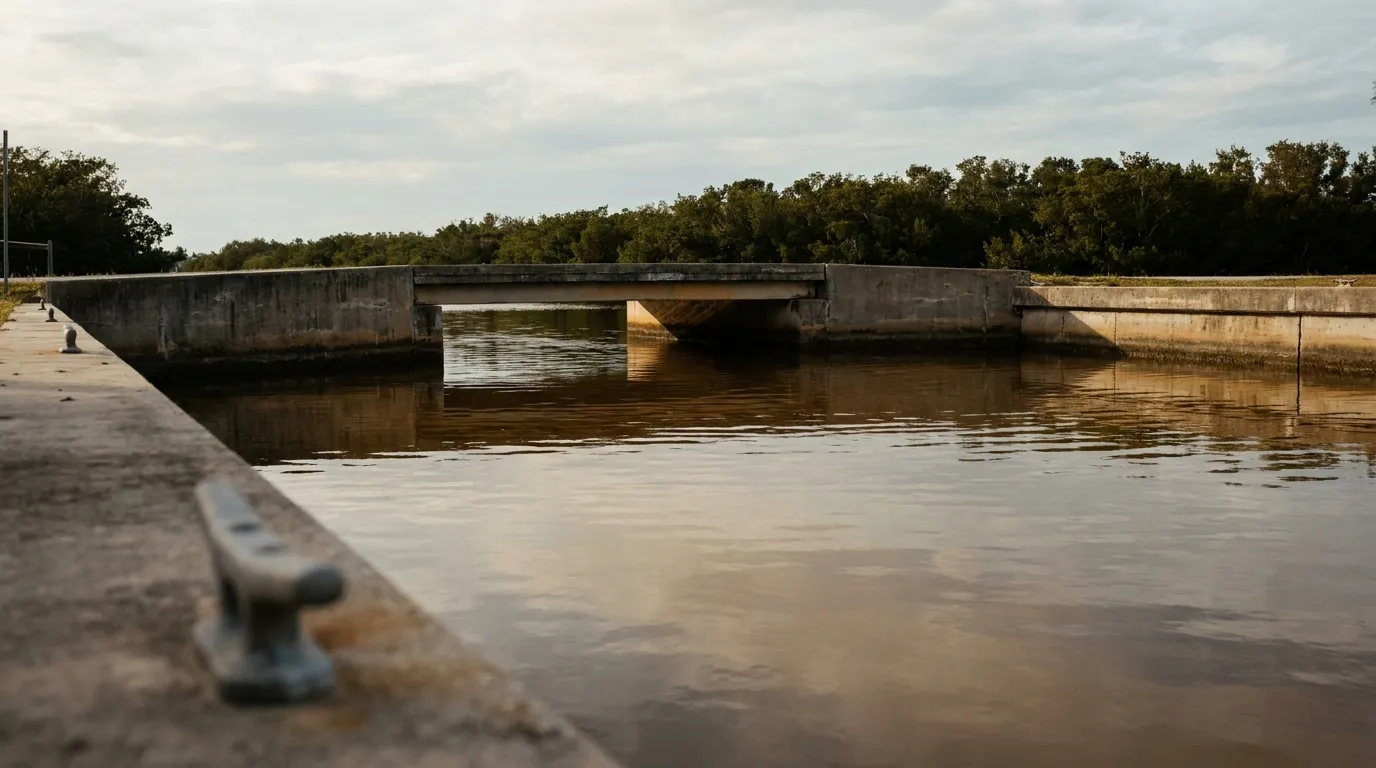
A buyer sends me a listing every week that says Gulf access in the headline. Half the time the canal behind the house does have Gulf access. The other half, the water goes to the Gulf and the buyer's boat does not. Those are two different sentences.
The mistake that costs the most money
The listing description is written by the agent representing the seller. Gulf access is a claim about water, not about your boat. A canal can technically reach open Gulf while passing under a fixed concrete bridge with 8 feet of vertical clearance. If your center console has a T-top at 9 feet 6 inches, the canal is not accessible to you. It is accessible to a jon boat.
By the time this is discovered, three things have usually already happened: the offer is accepted, the inspection is paid for, and the buyer has told family they bought a Gulf-access home.
Both statements can be true at once: the canal has Gulf access, and your boat cannot get out. Only one of them belongs in your decision.
Why one city has this problem more than most
Cape Coral was built water first. The canals were cut, then the lots sold along them, then the houses built. The city publishes more than 400 miles of canals by its own count, split into five separate saltwater systems — SW-A through SW-E — plus a landlocked freshwater network. Two houses on adjacent streets can sit on completely different water. One reaches the Gulf. The other is a beautiful pond.
The city also publishes vertical clearance for 122 of its 159 bridges. Reported clearances over the saltwater canals run roughly 7.9 to 11.75 feet. That range decides which boat you can own here. Not the listing headline.
The four checks that separate the claim from the reality
Before I let a buyer write an offer on a Cape Coral waterfront home, we work through the same list. In this order.
- Which system is this canal on? SW-A through SW-E each have their own path to open water. Confirm the system in writing, on the address, from a source that is not the listing.
- Are there fixed bridges between this dock and the river? A fixed bridge is concrete and does not open. Count them. One is enough to cap your boat.
- What is the lowest published vertical clearance on that route, at high tide? Clearance is measured to mean high water. On a king tide, you lose more. Whatever the boat you want or already own needs above the waterline, add a safety margin, and then compare.
- What is the controlling depth at low tide? Clearance is the ceiling. Depth is the floor. A canal you can leave at noon may not float you at dawn.
Any one of those four can make a Gulf-access address the wrong house for your boat. All four have to pass.
What "direct" actually means, and what it does not
The word buyers hear
When a listing says direct Gulf access, most out-of-state buyers read it as: back the trailer down, drop the boat, run to the pass. Sometimes that is the house. Often it is not.
The word the industry uses
There is no legal definition of direct here. In practice it usually means no fixed bridges between the dock and open water. It does not promise a depth. It does not promise a route length. It does not promise your specific boat will make it under the one bridge the seller does not consider fixed.
This is where a buyer agent earns the engagement. The listing agent is doing their job — getting the seller the best price. Someone has to be reading the same listing with your boat's air draft in one hand and a bridge clearance map in the other.
What the sellers themselves usually know
Owners who actually use their boat can answer the four questions in about ninety seconds. They will tell you the tide window they leave on, the bridge they duck under, the sandbar their neighbour hit. That is the disclosure you want. Ask.
Owners who bought the house for the view and never launched the boat cannot answer any of them. That is also useful information. It usually means the seller is telling the truth as they understand it, and no one has ever pressure-tested the claim.
What this post does not do
This is not a promise about any specific address. Canal systems, bridge clearances and tide behaviour change, and city records are updated on their own schedule. Every waterfront address needs its own check, run against the boat you actually intend to keep behind it. Send Stephanie the address before you fall for the photos. She would rather lose the sale than watch you buy on a canal your boat cannot get out of.
Where these facts come from
- City of Cape Coral — canal system count and structure (five saltwater systems SW-A through SW-E, plus freshwater).
- City of Cape Coral — published vertical clearance data for 122 of 159 bridges, saltwater range approximately 7.9 to 11.75 feet.
- Sunshine Endeavors internal buyer-representation checklist, Stephanie DeLisle.
General information for prospective Southwest Florida buyers. Not legal, tax or insurance advice. Stephanie DeLisle, REALTOR® — Experience Real Estate Group, LLC, 1217 Cape Coral Pkwy E #359, Cape Coral, FL 33904. Florida license 258024795. Equal Housing Opportunity. Last verified: 2026-09-17.