
Things to Do · Cape Coral
How to Plan a Sunset Kayak Trip in Cape Coral
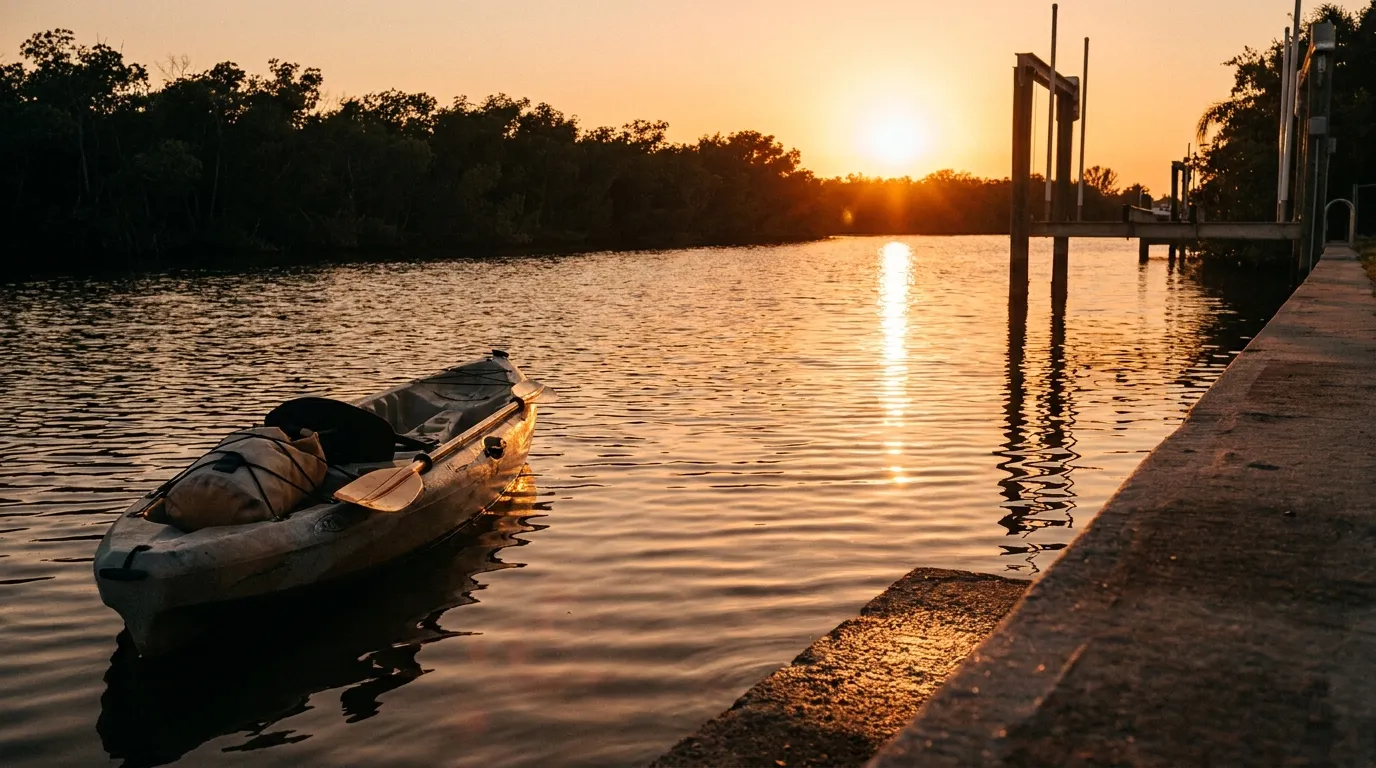
A sunset kayak in Cape Coral is one of the easiest good evenings you can have here. It is also the one people most often get wrong, because they leave too late, launch from the wrong place, or point the boat in a direction that puts the sun behind their shoulder instead of in front of it.
This is a step-by-step version of what actually works. It assumes you have never paddled a Cape Coral canal before and that you want to be back at the truck before it gets dark.
Step 1: Decide which sunset you are chasing
There are two honest options in Cape Coral, and they are not the same evening.
- The canal sunset. You launch on a residential saltwater canal, point west, and paddle down a straight corridor of seawalls and back yards while the sky changes. Calm water, almost no wake, dolphins are possible but not the point.
- The open-water sunset. You launch somewhere that gives you access to the Caloosahatchee River or Matlacha Pass and paddle out onto real water. Bigger sky, better colour, more wind, more boat traffic, and you need to know what you are doing.
If this is your first paddle here, do the canal version. The open-water version is a second-trip idea.
Step 2: Look up the actual sunset time, then subtract 90 minutes
Search "sunset Cape Coral" for the exact date of your paddle. Take that time and count backwards ninety minutes. That is when you launch.
The good light starts about forty-five minutes before sunset and ends about fifteen minutes after. If you launch at sunset, you have missed it.
Ninety minutes gives you time to get the kayak in the water without hurrying, paddle out fifteen or twenty minutes, sit through the whole colour show, and paddle back with usable daylight. In September, sunset in Cape Coral falls in the mid-to-late 7pm range, so a 6pm launch is a safe rule of thumb — but check the day you are actually going.
Step 3: Pick a launch that faces the right way
You want a put-in where you can paddle roughly west without hitting a dead end for at least twenty minutes. Two options that regularly work:
- Horton Park boat ramp on the south end of the Cape. Small park, ramp, restrooms, parking. Puts you straight onto the Caloosahatchee. West is right there.
- Rotary Park Environmental Center in south Cape Coral. A quiet paddle into mangrove creeks off Rosen Park and the surrounding canal system. Lower drama, more wildlife, protected water.
If you are staying at a rental with a private dock on a Gulf-access canal, that is your launch. Point the bow whichever way the sun is going down and paddle for twenty minutes. Turn around when the sun is a hand's width above the rooftops.
Step 4: Rent the boat before you rent the boat
Call the rental shop the morning of, not the afternoon of. Ask three questions, in this order:
- Is a sit-on-top single available for a two-hour evening rental starting at [your launch time]?
- Do you deliver to the ramp, or do I pick up and transport?
- What time do I need to have it back?
The third question is the one people forget. Some shops close at sunset. If your return time is 7:30pm and sunset is 7:35pm, you will be paddling hard through the best light of the evening trying to make a deadline. Book a shop whose return window is at least thirty minutes after sunset, or rent for the full day and drop it back in the morning.
Step 5: Pack the five things that make or break the trip
Not a full kit list — just the five that matter for an evening paddle.
- A dry bag with a headlamp inside. Not "a flashlight on your phone". A real headlamp. If you end up on the water after dark, Florida law requires a white light you can show to other boats, and your phone will not cut it.
- Long sleeves and long pants of some kind. The mosquitoes come out at exactly the hour you want to be on the water. A thin sun shirt does both jobs.
- Water. More than you think. One litre per person per hour, minimum, even after the sun is off you.
- A whistle clipped to the PFD. Legally required, and the only signal that carries across a canal at dusk.
- The address of your launch, saved offline. Cell service on the water is fine most places, but you will not want to be searching for directions with wet hands.
Step 6: Read the tide before you leave the parking lot
Cape Coral canals are saltwater and tidal. A paddle out on an outgoing tide and a paddle back on an incoming tide is the easy version. The reverse is the version where you finish in the dark, tired.
Pull up a free tide chart for Cape Coral (NOAA has one) and check what the water is doing during your paddle window. If the tide is against you on the way out, paddle a shorter distance out before you turn around. That is the whole trick.
What this post does not cover
This is not a guide to overnight paddling, to open-Gulf crossings, or to fishing from a kayak. It is not a review of specific rental companies — those change, and we do not publish rankings. If you want a longer or more ambitious trip than a two-hour evening loop, hire a guide the first time. The people who run guided sunset paddles here do it every night and know which canal is glassy in a north wind and which one is a chop factory.
The version from our own dock
Guests at the Cape Coral Adventure Package and the Luxury Escape have kayaks and paddleboards on-site and a private dock to launch from, which removes about half the steps above. You still need the sunset time, the headlamp, the water and the whistle. You do not need the ramp, the rental call, or the drive.
If you are still deciding where to stay, come see the three homes and pick the dock that fits the trip you are actually taking. See the three homes.
Where these facts come from
- Sunset times: NOAA Solar Calculator, checked for Cape Coral, FL.
- Tide data: NOAA Tides & Currents, Cape Coral station.
- Florida navigation-light and PFD requirements: Florida Fish and Wildlife Conservation Commission (FWC) boating regulations.
- Horton Park and Rotary Park Environmental Center: City of Cape Coral Parks & Recreation.
- Last verified: 2026-08-15.